
Axon & Flock: Unlicensed, Unsafe, Unconstitutional.

California’s licensing division for alarms, security monitoring, showed Axon Alarm as suspended circa 12/31/2024
Read this first. Everything below comes from publicly available information: state licensing lookups, regulator websites and statutes anyone can open in a browser. Nothing here is proprietary, leaked or insider. It is one concerned citizen's appraisal, it may contain errors, and licensing records change. Before you repeat a claim from this page, check it against the relevant state authority yourself. The full methodology, state-by-state tables and caveats are in the whitepaper that I’m happy to share. Contact me by email.
I didn't set out to write a fifty-state report. I set out to answer a simple question about my own city: if a company is going to bolt cameras to our utility poles and read every license plate that goes by, is that company licensed to do that kind of work here the way an alarm installer or a security firm would be?
The answer for North Carolina turned out to be no in Axon’s case, at least as far as the public record shows. What follows is the result of that work: privacy-oriented sweat and grit, a spreadsheet, and a lot of tabs.
Every state has its own rules for who may install and operate security and surveillance systems. I simply asked each state whether Flock and Axon appear in the books.
How I did it
For each state I asked three questions using only public sources:
Does this state require a license for companies that install or operate security, alarm or surveillance systems, and does that requirement plausibly reach license-plate-reader networks?
If so, does Flock Safety or Axon appear in the state's public license lookup, and in what standing?
If I can't answer either question confidently from the public record, I say so, rather than guess.
Or I called the regulatory authorities. Like in Arkansas, the state police told me no, neither Flock nor Axon are licensed at all.
That gives every state one of six labels: licensed, partial license, required but missing, unclear, suspended, or not required. To keep myself honest I ran the same method on a dozen established security integrators — the Convergints, Securitases and Johnson Controls of the world — and they overwhelmingly show up as licensed in the states that require it. The method finds licenses when they exist. If you want the maps, skip to the bottom.
What the maps say
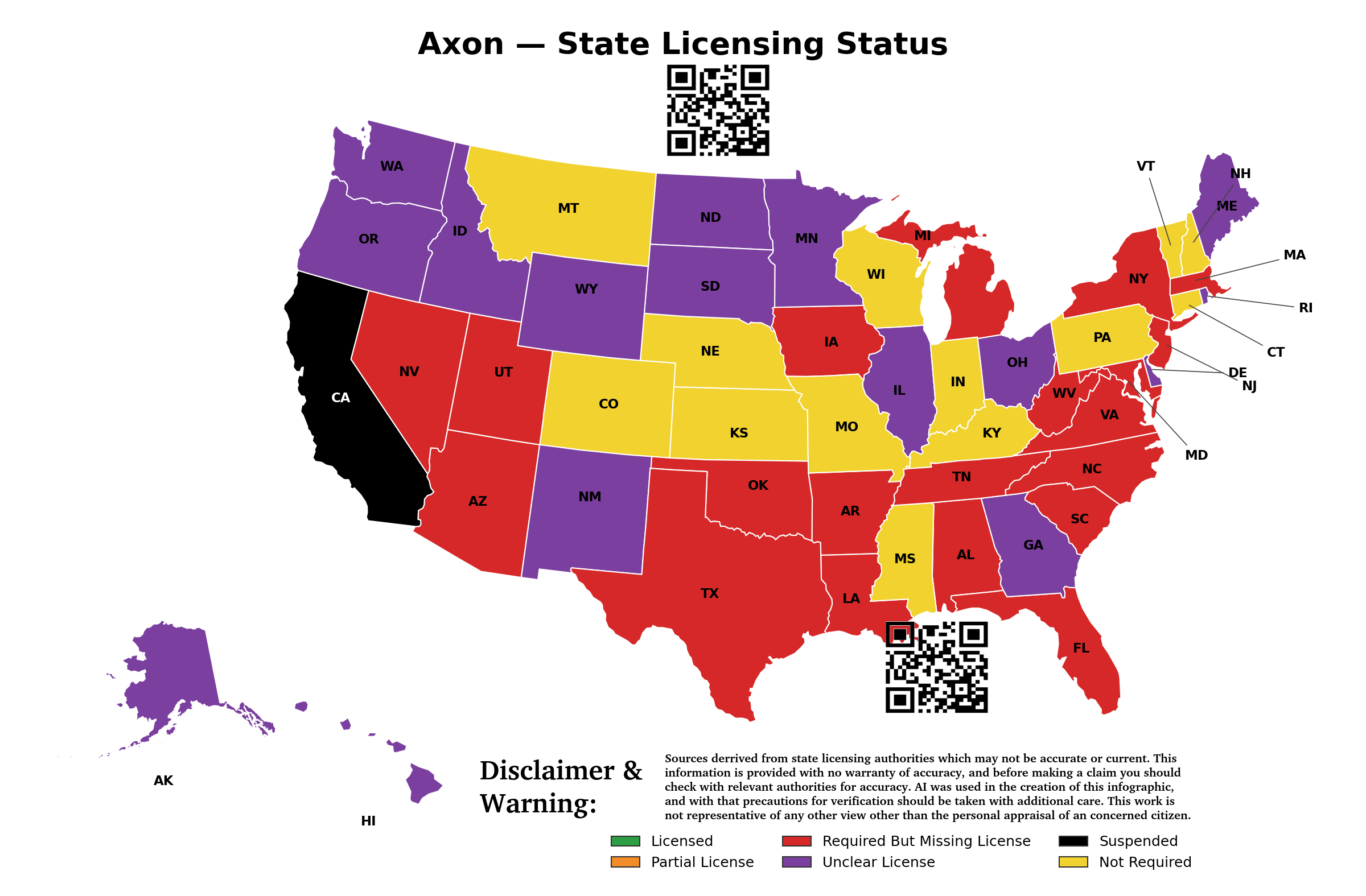
In many states, Axon not only wasn’t licensed, but in California was suspended by the state according to regulatory filings and licensing under the Axon name. Their compliance department is pretty busy I guess.
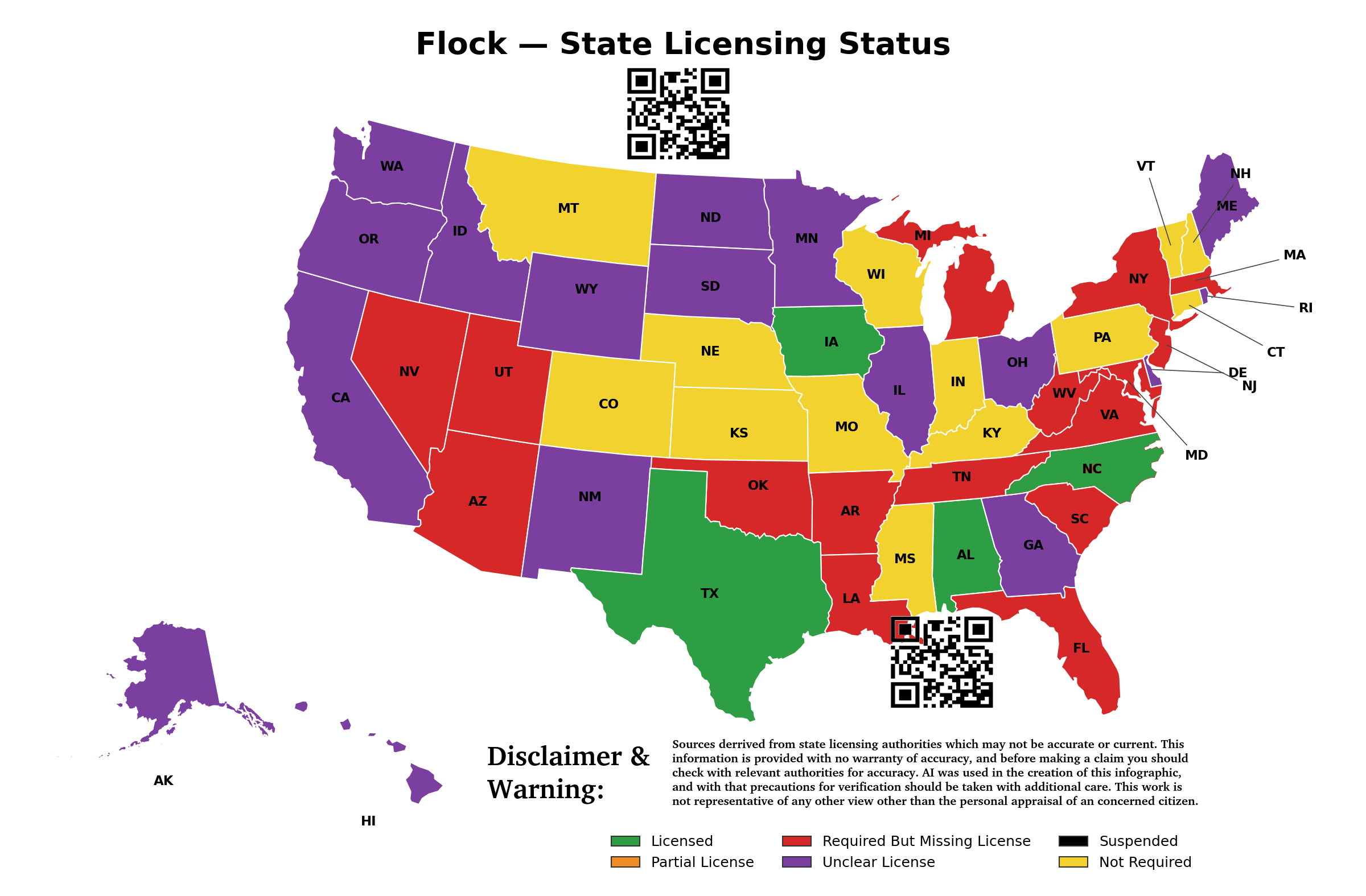
Flock appears to have gotten some licenses, not as many as their smaller, more traditional competitors, but pursued licensing in a few states, including Texas and North Carolina when directed to do so by state authorities.
Of the fifty states, my review found twenty-one where a license appears to be required for this kind of work (twenty-two if Connecticut counts — my own data is inconsistent there, and the whitepaper says so). In those states:
Flock shows a current license in three — Alabama, Iowa, North Carolina and Texas — is missing from the registry in seventeen, and in California I could not determine its status from the public lookup.
Axon shows a current license in none. It is missing from the registry in twenty and carries a suspended license in California.
Another sixteen or seventeen states are genuinely unclear, either because the statute is ambiguous or because the state's lookup tool can't answer the question. Thirteen states don't appear to require a license at all. That is not a compliment to those thirteen; it is a gap in the law.
In the states that regulate this work, the two companies most eager to watch us are, by the public record, mostly unaccounted for.
I want to be careful about what this does and doesn't mean. A missing registry entry is not a court finding. Companies sometimes work through licensed local subcontractors, register under a different corporate name, or hold a license type I didn't search. Some of these states may have exemptions I missed. That's why the labels are conservative, why "unclear" is a real category, and why the whitepaper lists exactly what I looked at so you can check my work and tell me where I'm wrong. I'd rather be corrected than be quietly mistaken.
But it also means this: in a lot of states, the question "is this vendor licensed to do this?" has never been asked out loud by the people signing the contracts. It's a question any city council member, county commissioner or sheriff can ask before the next vote, and it's one a vendor should be able to answer in a sentence.
What you can do with this
If your state is red on either map, you have a concrete, non-ideological question to bring to your local government: show me the license. If it's purple, ask your state regulator to clarify whether plate-reader networks fall under the existing security-system rules. If it's yellow, ask your legislators why a company can read every plate in town without the paperwork an alarm installer needs.
None of this requires a lawyer or a lawsuit. It requires a public records request, a phone call, and a couple of minutes at a podium. I've done a lot of that in Asheville, and I'm happy to help you do it where you live.
Fighting Flock or Axon in your state? Call me.
If you have a question about your state, think I got something wrong, or want to push back on plate-reader surveillance where you live, reach out. I'll share what I have, help you figure out who to ask, and show up if I can. It's free. I do this because I care about our country and our Constitution.
You can email james@columbia.tel for more info, help, or if you want to set up a call.
Or visit columbia.tel/fight. Flock and Axon have a lot of money. I have a phone and a spreadsheet. Leave a voicemail, text or email and I’ll get back to you ASAP.
